
Rewiring Climate Capital to Unlock Women-Led Innovation with Carmel Rafaeli
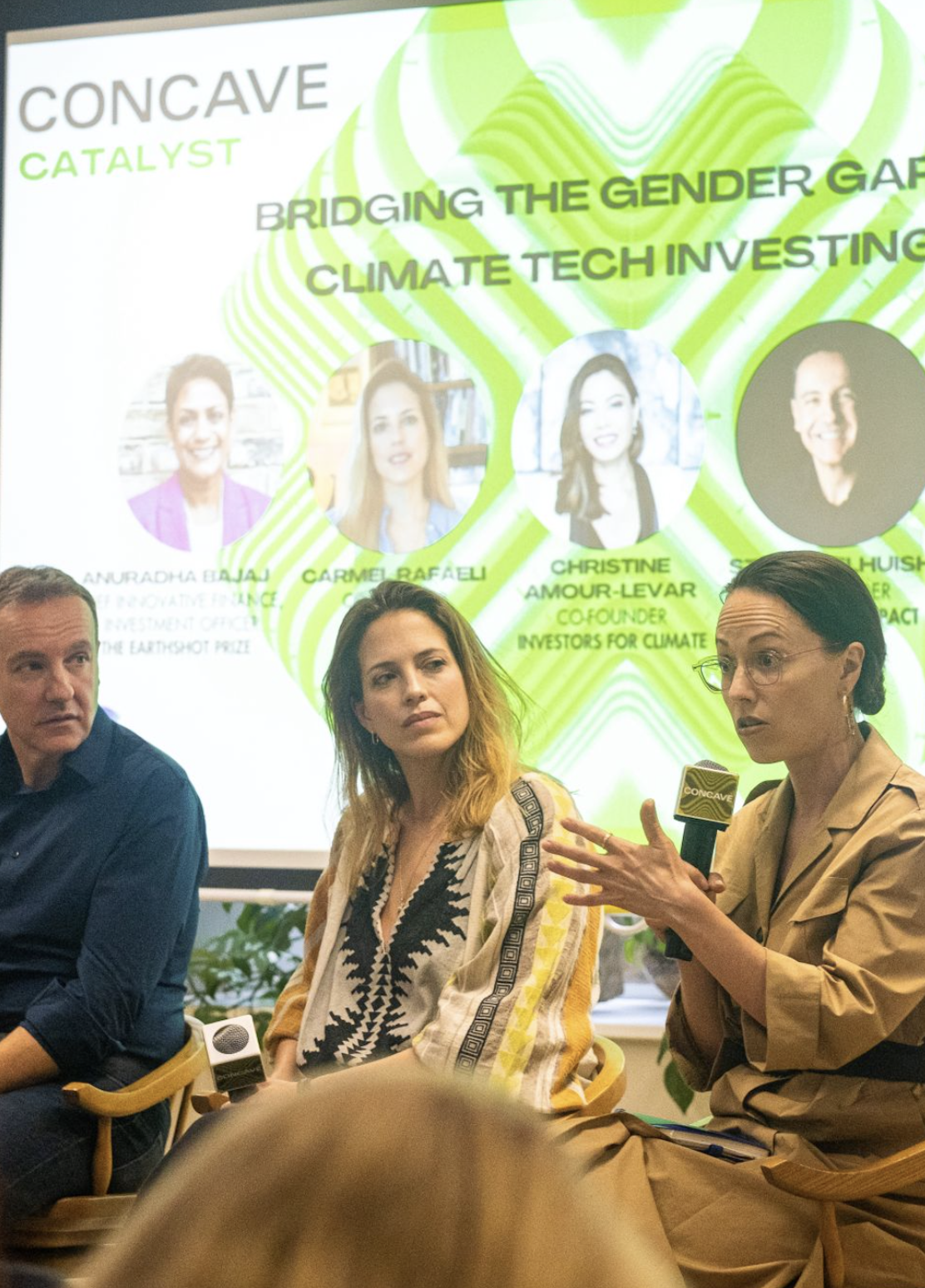
Carmel Rafaeli
Carmel Rafaeli supports early-stage climate ventures - as an Angel Investor, advisor, mentor and Venture Partner at the Conduit Connect. Founding Partner at The Table, an evergreen philanthropic vehicle and investor community advancing funding for women (co)led climate ventures through recoverable grants alongside community co-investment. Building a new capital model that unlocks bold, early-stage innovation - no equity, no debt.
She has been an entrepreneur for the better part of her career, with 15+ years of experience in bringing innovation to life in a variety of products and platforms in the tech and non-tech sectors. Doing everything from brick and mortar fashion to hospitality tech and IP tech. Focusing on Climate and Sustainability for the past 6 years, Carmel spends much of her time helping to accelerate sustainable innovation by creating better connections between innovators, corporates and investors.
“Backing women in climate isn’t a side conversation — it’s one of the most underleveraged opportunities to unlock better solutions and faster progress.”
Carmel, tell us about how your work intersects with the impact space.
I work at the intersection of climate, capital, and gender. I’m the co-founder of The Table, an evergreen philanthropic vehicle and investor community advancing funding for women (co)led climate ventures through recoverable grants alongside community co-investment.
My background is entrepreneurial rather than traditional finance. I’ve built companies, experienced failure, and learned firsthand how profoundly capital shapes outcomes. During COVID, I had a moment of clarity: whatever I did next had to do well financially, but also do good in the world. That led me to climate — not as a niche, but as a lens through which all innovation should be viewed.
Through angel investing, mentoring, and now The Table, my work focuses on fixing early-stage climate capital. We bring together VCs, syndicates, family offices, and corporate investors to co-invest — faster, smarter, and more collaboratively — in women building real-world climate solutions. Alongside that, we recently launched a philanthropic vehicle that will provide recoverable grants to match these investments with catalytic, non-dilutive capital — helping founders move further, faster.
A core belief behind this work is that funding women isn’t a side issue — it’s one of the most underleveraged opportunities in climate. Women are building credible, high-impact solutions across materials, energy, food, and infrastructure, yet receive a fraction of available capital. When that gap closes, we won’t just unlock fairness — we unlock better solutions, stronger businesses, and faster climate progress.
Impact, for me, isn’t separate from business. It’s embedded in who gets funded, what gets built, and how quickly solutions scale. When capital flows differently, outcomes change — for founders, for markets, and for the planet.
What is your own definition of impact?
Impact is measurable progress toward a better future — achieved through sustainable, financially viable systems. I don’t see impact and profit as opposing forces. In fact, I’m wary of impact that isn’t economically grounded. Solutions that rely solely on goodwill rarely scale. True impact endures because it makes sense in the real world — commercially, environmentally, and socially. At its core, impact answers three questions: Does this materially improve outcomes for people or the planet? Can it sustain itself financially? Does it shift systems, not just symptoms? I believe impact must be net positive. It’s not enough to solve one problem while quietly creating another. That requires asking harder questions — about supply chains, unintended consequences, and who benefits. Finally, impact is about who gets to build. When women and diverse founders have access to capital, different problems get solved — often more pragmatically, more efficiently, and with longer-term thinking. That, to me, is impact at its most powerful.
Carmel, what do you see as the most important issue to address in the next 10 years?
Fixing how capital flows.
We already have extraordinary founders building credible climate solutions. What’s slowing progress isn’t a lack of innovation — it’s friction in early-stage funding, misaligned capital, structural gaps in how companies are financed as they scale, and persistent bias in who gets backed.
Unlocking women-led innovation is particularly urgent. By underfunding half the talent pool, we’re leaving enormous economic and climate value on the table.
Moreover, scaling climate solutions requires mixed capital stacks. Equity is essential, but it cannot do the work alone. It must be complemented by debt, blended finance, philanthropy, and government grants — deployed intentionally and collaboratively, not in silos. Climate is a systems challenge, and it demands coordination across investor types, institutions, and sectors. Too many companies fail not because the technology doesn’t work, but because the funding model no longer fits the business.
We also need to be more intentional about liquidity. Climate is a long-term play, but long-term capital still needs pathways to recycle. Creating liquidity opportunities — through corporates, structured secondaries, and alternative exits — will unlock more capital earlier and bring new participants into the ecosystem.
By fixing how capital flows — across stages, instruments, and time horizons — we dramatically accelerate the climate solutions we already know the world needs.
What is the greatest challenge you face to scale your impact?
The biggest challenge is that our systems are still built for speed, not for reality.
Climate ventures often operate in the physical world — shaped by regulation, infrastructure, supply chains, and long time horizons. Yet we too often continue to fund and evaluate them using models designed for fast-scaling software.
At the same time, we’re not pricing reality properly. In the push for pursuit of price parity and short-term competitiveness, we too often ignore how climate externalities will reshape supply and demand. Scarcer water, degraded soil, extreme heat, and fire risk aren’t abstract future threats — they materially affect cost structures, asset values, and business resilience. When capital fails to price these realities in, it favours the status quo and penalises the solutions designed to address them.
Fragmentation is another barrier. Capital, expertise, and networks remain siloed — equity here, grants there, corporates somewhere else — while founders are left to stitch together funding and partnerships on their own.
And of course, bias remains a structural blocker. Women and diverse founders are still underfunded, over-scrutinised, and asked to do more with less — an inefficiency we can no longer afford.
If we want to move faster, we need to redesign the system itself so we stop losing time we don’t have. We need to align capital, risk, and incentives with the world as it is, not as it used to be.
“Climate innovation isn’t the bottleneck — capital is. When funding flows differently, outcomes change for founders, markets, and the planet.”
Carmel, what is your long-term vision and how do you measure & quantify your impact?
My long-term vision is to change how climate capital works — permanently. Through The Table, we’re building infrastructure for collaboration: a place where investors co-invest, share conviction, and move faster to support women-led and women-co-led climate ventures. Alongside this, we’re launching The Table, an evergreen philanthropic vehicle, deploying recoverable grants as catalytic, non-dilutive capital to level the playing field. With these grants, we incentivise co-investment, accelerate the growth of essential climate innovation, and close the funding gaps for women founders. I measure my impact across three layers:
Company outcomes: ventures funded, rounds closed, solutions scaled.
Capital unlocked: funding flowing into women-led climate companies.
System change: measurable shifts in investor behaviour toward collaboration and inclusion
Success, for me, looks like hundreds of women (co)led climate companies funded - not as exceptions, but as the norm. And an ecosystem where capital is aligned, collaboration is the default, and doing good and doing well are no longer separate conversations.
What are some misconceptions you’ve noticed regarding what “impact” is all about?
One of the most persistent misconceptions is if you’re focused on climate or social outcomes, you must be compromising on commercial rigor. In reality, the opposite is often true. The most credible impact solutions I see are deeply grounded in market demand, operational discipline, and long-term value creation. Impact isn’t a trade-off — it’s a signal of resilience and long-term relevance.
Another misconception is that for an impact company to be investable, it should be built for hypergrowth or unicorn-scale outcomes. Many climate solutions operate in the physical world — materials, infrastructure, food systems, and nature-based solutions — where progress is tangible but growth curves differ. These businesses can be profitable, resilient, and transformative without fitting what is sometimes perceived as a traditional venture capital template.
Finally, there’s a misconception that impact is niche. Climate isn’t a vertical — it’s a filter. It touches every sector, every supply chain, and every investment decision. The sooner we treat it that way, the faster real solutions can scale.
Get Involved
Interested in connecting with our private global network of investors, founders, and experts building real, scalable solutions? Learn more and apply to join the Top Tier Impact Network and access future convenings, collaborations, and deal flow.